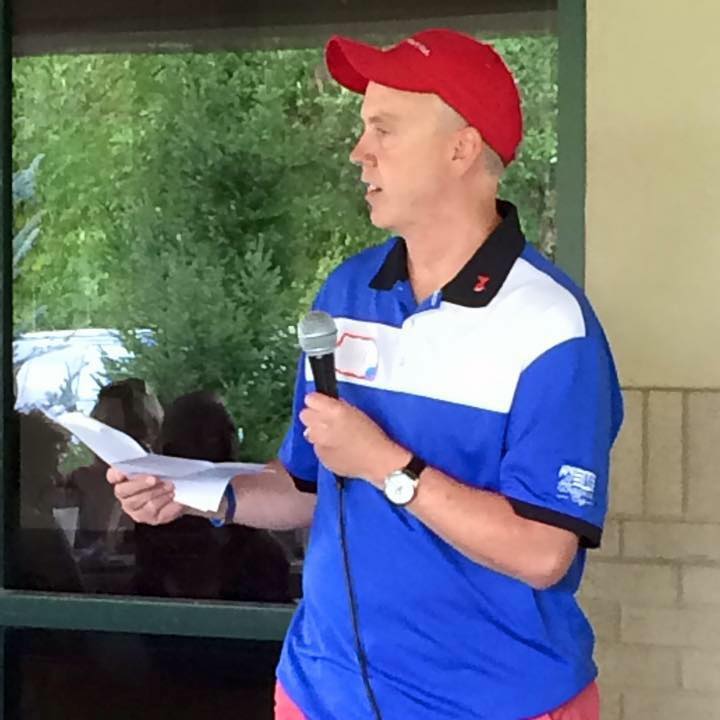
 The Idaho Statesman published my Guest Opinion this morning. October 29, 2015 is "World Stroke Day." I published this to help raise awareness about strokes.
The Truth About Stroke – World Stroke Day
is October 29
About 800,000 people in the United States
have a stroke every year and someone dies from one every four minutes.
On January 10, 2012, I had a
stroke. And three days later, while in the hospital, I suffered a massive
stroke. My right arm was partially paralyzed. I lost all communication:
speaking and writing. I did not know my own name.
Before my strokes, I was a lot like you – a
busy Dad, working hard to support my family and I thought I was in good
health. I was an elected official as a board member at the College of
Western Idaho and Executive Director of the Associated General Contractors, a
large trade association. I was a prominent state lobbyist and educator. I was a
master multi-tasker making presentations and speeches throughout the nation.
Even more importantly, I was a husband and the father of a six-year old
boy.
The truth is stroke is the world’s
second-leading cause of death and No. 5 in the United States. It’s also a
leading cause of long-term disability – though largely preventable and
treatable. Fewer than one in 10 people know what each F.A.S.T. letter means and
one in three people can’t name any stroke signs, according to American Stroke
Association studies.
As part of World Stroke Day on Oct. 29, the
American Heart Association/American Stroke Association is urging Idahoans to
learn the warning signs of stroke. Personally, I can’t emphasize knowing the
signs of stroke – it happened to me – it could happen to you or a loved one.
F.A. S.T. has four sudden signs of stroke.
When you spot any of the four signs, call 9-1-1 for help right away.
F.A.S.T. is:
Face Drooping – Does one side of the face
droop or is it numb? Ask the person to smile. Is the person's smile uneven?
Arm Weakness – Is one arm weak or numb?
Ask the person to raise both arms. Does one arm drift downward?
Speech Difficulty – Is speech
slurred? Is the person unable to speak or hard to understand? Ask the person to
repeat a simple sentence, like "The sky is blue." Is the sentence
repeated correctly?
Time to call 9-1-1 – If someone shows any
of these symptoms, even if the symptoms go away, call 9-1-1 and get the person
to the hospital immediately. Check the time so you'll know when the first
symptoms appeared.
After my strokes, I endured years of intense occupational, physical, speech and vision therapy.
At the time, I thought life was over. It’s a daily struggle, but with the
support of my family and friends I have beat many odds. I am so grateful for my
second chance in life.
Today I am still on the Board of the College of Western Idaho and was appointed
by Governor Butch Otter to serve on the Board of Commissioners Idaho Housing
and Finance Association. I’ve also become
a strong advocate for stroke prevention and awareness and proudly serve as a
board member for the Idaho American Heart Association/American Stroke
Association.
If you remember
one point from my story, please remember this: A stroke is devastating and it can
happen to anyone. Know the four F.A.S.T. signs of stroke – it could just save
your life or a loved one’s.
To learn more
information about the symptoms and warning signs of stroke, please visit www.heart.org.
Mark P. Dunham
Comments