 Three
recent events made me realize that I have come so far since my strokes. On the
other hand, I also know what I have lost. My recovery is bittersweet.
Three
recent events made me realize that I have come so far since my strokes. On the
other hand, I also know what I have lost. My recovery is bittersweet.
The
three events were:
- The Western Idaho Fair
- The “Saving Strokes Golf Tournament” sponsored by the American Heart and Stroke Association
- The opening game of the Boise State football season
I
have gone to the fair and Boise State football games for decades. My friends
and I have loved to attend those events.
Those
three events tested my ability to participate for many reasons. When you have strokes, you are very sensitive to your visual and sensory perceptions.
Therefore, I need to keep
distractions and noise down.
The
fair and the football games were sensory
overload.
At the fair, it was hot. People
were everywhere. The sounds and the lights were intense. In addition, because
of my strokes, I have vision loss. Mainly, my right peripheral vision is gone.
I was careful; however, I was jostled and bumped. I was so hot that I was
worried I might have a seizure. It took a few days to recover.
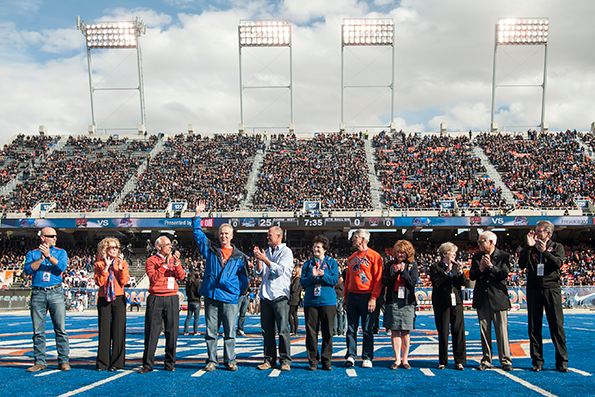 I did attend a game after my strokes. I was honored to be
one of the 2012 Boise State Distinguished Alumni. At halftime, I was on the
field. It was an honor. However, part of the perks of that award was being in a
suite rather than in the stands with bleachers. In the suite, crowd noise were muted. I did not notice noises.
I did attend a game after my strokes. I was honored to be
one of the 2012 Boise State Distinguished Alumni. At halftime, I was on the
field. It was an honor. However, part of the perks of that award was being in a
suite rather than in the stands with bleachers. In the suite, crowd noise were muted. I did not notice noises.
Going to the first game as a regular fan last
Friday was physically and emotionally horrendous.
Tailgating was a haze of lights, colors, loud crowd
noises, etc. That was just the
tailgating!
 |
| BSU Game September 4, 2015 |
Climbing to the top of Albertson’s
Stadium was even worse. The chant -- “Boise! State!” -- hurt my ears. The nonstop
light’s from the scoreboard, the massive loud crowd noise, and my lack of depth
perception because the loss of my right peripheral made me actually scared.
I had to leave at halftime. It
took me three days to recover.
Two days before the game, I participated
in the American Heart and Stroke Association “Saving Strokes Golf Event.” Though I cannot golf again because I had a torn carotid artery which caused my
strokes, I helped plan this event. It
was for stroke survivors and their caregivers. The point of the event was to raise awareness
that people who have strokes can be active again.
The organizers (which I realize
would be “ME” because I am on the Board!) asked me to speak about my
strokes. I am actually tired of talked
about my strokes. It’s been almost 4 years. Nevertheless, I do those presentations
to try to give hope.

Just preparing for a simple presentation
is tough. As I explained when I did my speech, when you made your living doing
speeches and presentations and you lose ALL communication because of stroke, it was especially hard to talk about “me.”
The aphasia makes it difficult to
read so rehearsals are not really possible. The aphasia also make “word finding”
challenging.
I did the presentation. I got
flustered at the beginning which compounded my frustration. A hallmark of
aphasia is “l know what to say, but I could not get the words out.”
Here is a video of the presentation:
There are some tips that I should
have done before my appearance. Of course, I did not prepare enough obviously!
- Give you plenty of time to answer questions and allow time for you to understand instructions. After a stroke, it will take you longer to process what has been said.
- People who have had a stroke may have speech or language problems. Here are some tips for your family and care givers:
- Use simple words and sentences, speak slowly. Ask questions in a way that can be answered with a yes or no. When possible, give clear choices. DO NOT give too many options.
- Break down instructions into small and simple steps.
- Repeat if needed. Use familiar names and places. Announce when you are going to change the subject.
- Make eye contact before touching or speaking if possible.
- Use props or visual prompts when possible. DO NOT give too many options. You may be able to use pointing or hand gestures or drawings. Making a book with pictures or words about common topics or people will help to communicate better.
 After
the event, I was talking with a nurse and I said, “It seemed like I was NOT a
stroke survivor. Rather, I was just helping out like I did throughout my
career.”
After
the event, I was talking with a nurse and I said, “It seemed like I was NOT a
stroke survivor. Rather, I was just helping out like I did throughout my
career.”
It
seemed “normal” other than my halting speech.
Those
three events – the fair, my speech, and the game – wiped me out more than I
thought. For days, I got headaches and needed more rest.
I
think I am human after all. "Abnormal!"
Comments